Guide: ERP Guided Controls, but For AI
AI does not need to become ERP, but it does need to learn the art of politely stopping to check desired outputs. ERP forces preconditions, AI often starts with action and reveals uncertainty afterwards.

ERP Lessons For AI
A practical guide for borrowing the useful discipline of old enterprise systems without turning AI into a paperwork dungeon.
AI does not need to become ERP, but it does need to learn the art of politely stopping to check.
Use this when
Use this when AI is being used for work that depends on required inputs, approvals, ownership, data lineage, financial impact, compliance, customer promises or operational decisions.
The basic problem
AI can generate an answer even when the work is not ready. That is powerful for brainstorming, but risky when the answer may be used as evidence, calculation, instruction or decision support.
The pattern
ERP forces preconditions before action: AI often starts with action and may only reveal uncertainty afterwards. The useful middle is not to make AI rigid for everything; it is to decide which questions require a readiness gate before the answer.
The check
List what must exist before the AI can answer safely. Example: for savings, require baseline cost, target process, adoption assumption and time period. For a policy summary, require country, employee group and effective date. If these are missing, the AI should ask, not improvise.
Not every missing detail should block an answer. For example: a brainstorming prompt can proceed with assumptions, but a finance estimate should not. Mark inputs as mandatory, helpful or optional. This keeps AI practical while preventing serious work from being built on missing foundations.
Write the moment where AI must pause. For example: “If the baseline is missing, do not estimate savings; ask for the baseline first.” This is not bureaucracy, it is the same common sense as an online form refusing to submit without an address, just applied to critical thinking tasks.
If the AI proceeds with assumptions, make them obvious. For example: “Assuming UK policy, full-time employees and 2026 rates.” This lets the human accept, correct or reject the answer. Hidden assumptions are dangerous because they make the output look finished when it is really conditional.
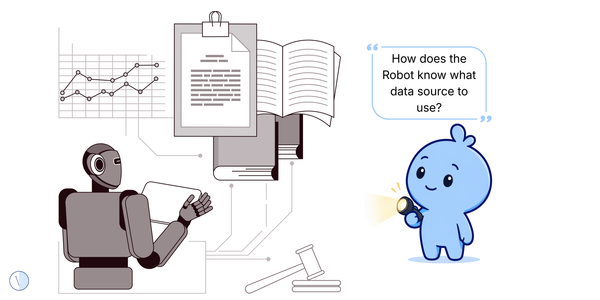
For work that depends on facts, name the source. For example: ERP table, approved policy, latest forecast file, signed contract, or official customer record. If the AI cannot identify the source, the output should be labelled draft, not truth. Those pesky labels matter aka show your working.
Ask who owns the result, for example: Finance owns savings, HR owns policy interpretation, Procurement owns supplier choices, Operations owns workflow impact. If nobody owns the output, the AI answer may become a wandering paragraph looking for someone to blame later.
If the AI cannot proceed, where does the user go? An example: ask Finance for baseline, ask HR for policy scope, ask IT for data owner, ask Legal for contract interpretation. A stop without a path is just frustration, a stop with a path is useful control.
When AI refuses or pauses, capture the reason in plain language, for example: “Missing supplier ID” or “No approved baseline.” Over time, these stop reasons reveal where the organisation’s data, ownership or process gaps actually sit, the refusal becomes a field note.
Make a small list of things AI must not guess: financial numbers, customer commitments, legal positions, safety instructions, regulatory claims, access permissions, identity, supplier status. This is the modern version of “missing cost centre” because Some fields cannot be vibes.
What good looks like
Good looks like AI that is still helpful, but not reckless. This means it can draft, explore and suggest, while also knowing when the work needs missing inputs before the answer becomes usable.
What to do next
Pick one AI use case and write three rules: what it must ask, what it may assume, and what it must never guess.
The Satire
The ERP stopped because one field was missing, while the AI output was a five-paragraph enthusiastic strategy doc because one field was missing.
Related Vieews paths
Guides are practical checks. Signals show the pattern. Playbooks hold the heavier structure when needed.
Chaos
The Blue Blob and the Very Strict ERP
The discovery scene that started this thread.
Signal
ERP Knows When Not To Proceed. AI Often Does Not.
The pattern behind this guide.
Playbook
Readiness Gate
Use the heavier structure when needed.
Useful context
Old systems can be annoying because they stop the work. New systems can be risky because they keep going. The interesting bit is not which one is better; it is what each system understands about readiness.
These are Vieews, not bibles, use as basic lenses, not prediction, investment advice, or a replacement for doing your own investigation. If a line makes the spreadsheet uncomfortable, excellent, ask one more question, tug on that thread (don't get fired!).