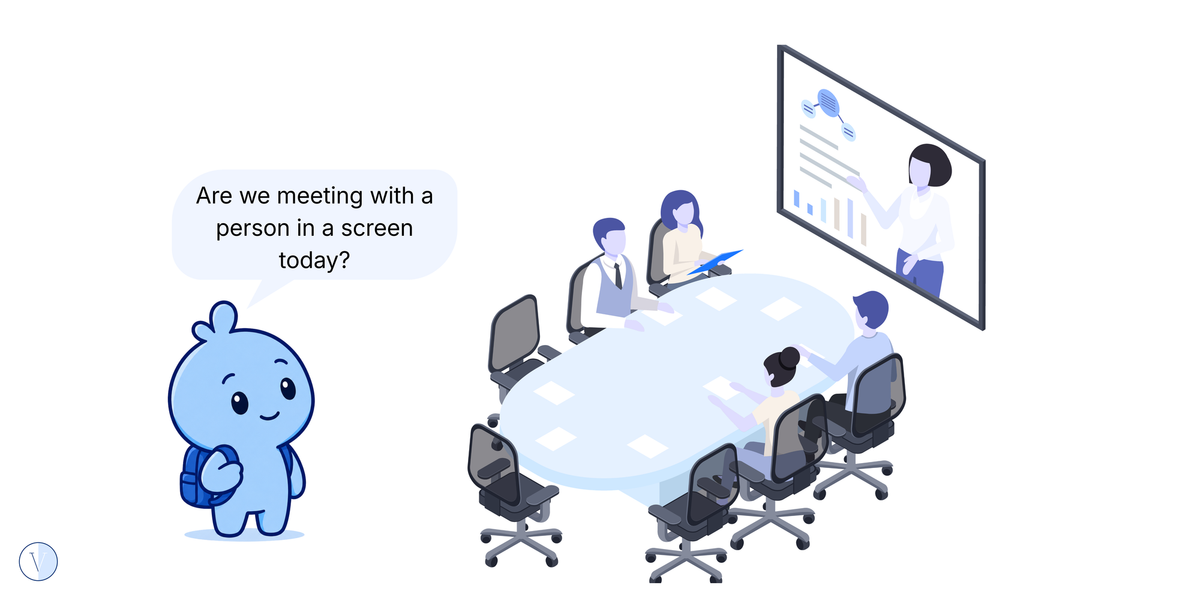
Quick check on how much heavy lifting that recurring meeting is doing for your formal operation systems. Have you ever wondered if the meeting should be part of your process maps?
Do you know what this is?
Ever wondered; is this meeting actually part of the integration architecture?
Five quick questions to help see whether the behaviour looks familiar before we name the pattern.
Question 1 of 5Results stay hidden until the end
Is this meeting actually part of the integration architecture?
Five quick questions, stick to what actually happens for best estimates, not what the formal process says should happen.
Multiple choice
When two teams need to align information, what usually connects them?
True / false
The meeting mainly exists to reconcile information, ownership or status across teams.
Pick the closest answer
How often does work wait for the next sync before it can move?
Finish the sentence
When numbers or statuses don't match, the usual response is…
Scenario check
If you cancel the recurring meeting for a month, what will tend to happen?
The meeting is not just talking about the work, it appears to be actively translating, reconciling and moving the work between boundaries.
We call this…
Meeting-as-Integration-Layer
A recurring meeting that functions as human coordination infrastructure because formal systems or interfaces do not connect the work seamlessly.
The four-part read
One pattern with four things worth noticing.
This is the same lightweight analytical structure used across the VIEEWS pattern library.
1
Spotting the gray zone
Recognition
The Official Process: Your company purchases specialized, top-tier platforms for different departments. Marketing has their tool, sales has theirs, and operations runs on a separate database. Of course, the corporate strategy slides assume an elegant, connected ecosystem.
The Reality: The platforms do not communicate natively because building custom API integrations is too expensive, or the fields don't map cleanly across organizational boundaries.
The Signal: Calendars are chronically clogged with recurring 30-minute status syncs titled "Alignment Hand-off," "Cross-Functional Review," or "Status Sync." Human beings (and meeting transcripts) are forced to act as the literal software middleware.
2
The immediate shockwave
Impact
The Calendar Production Line: High-salaried professionals, managers, and directors spend 40% of their week sitting in rooms verbally repeating, translating, and reconciling data that should be synchronized silently in the background.
The Decision Delay: Work slows to a crawl as nothing can move downstream until the scheduled weekly meeting occurs, creating artificial roadblocks where tasks wait for days just to get a verbal green light.
The Management Fuzz: Middle managers bear the brunt of the friction, spending their entire day bouncing between alignment calls just to manually stitch together fragmented information, ownership, and judgment.
3
The hidden utility and why the Pattern lives on
Benefits
The Dynamic Integration: It provides a cheap, instantly adaptable method of cross-boundary collaboration without writing a single line of code or waiting on a centralized IT queue.
The Context Engineering: Humans can resolve data mismatches, nuance, and unspoken corporate politics in real-time. A meeting injects immediate human judgment where a rigid software logic would simply fail or throw an error.
The Accountability Insurance: It forces distributed teams to physically or verbally create a temporary layer of alignment and shared ownership that keeps projects from falling through the cracks.
4
The long-term impacts if not recognised as what it is
Carry-Over Debt
The Coordination Burden: financial overhead can be huge i.e. the true cost of the missing software integration is paid continuously in corporate time, calculated by multiplying attendee hours by meeting frequency and loaded corporate costs.
The Process Erosion: "Talking about work" systematically replaces "doing work." The constant context-switching can destroy focus time for top performers, leading to organizational fatigue and widespread burnout.
The AI Blind Spot: When you try to layer automation or AI assistants onto this workflow, they fail because the actual integration logic isn't documented anywhere—it is scattered across 50 different meeting recordings and verbal agreements. Unfortunately, this means system can remain unscalable.
AI Impact. Meeting summaries can make the conversation more searchable without defining the integration logic underneath it. Watch for AI documenting the symptom while the same boundary still needs humans to reconcile it. Unfortunately, AI will still give you great transcript but not tell you if you wasted your time in that meeting.
One thing to notice next
Take this back into the wild of your workplace.
Pick one recurring meeting and ask: what would stop moving if this meeting vanished?
Behind the pattern
Same four lenses, every time.
Recognition, Impact, Benefits and Carry-Over Debt help us follow the gap between formal design and the work people actually build around it.
Recognition → Impact → Benefits → Carry-Over Debt
Deeper dives and toolkits coming soon.
For now, we are following the work to find recurring Patterns that are perhaps unrecognised as formal systems. Subscribe to to explore next Patterns.