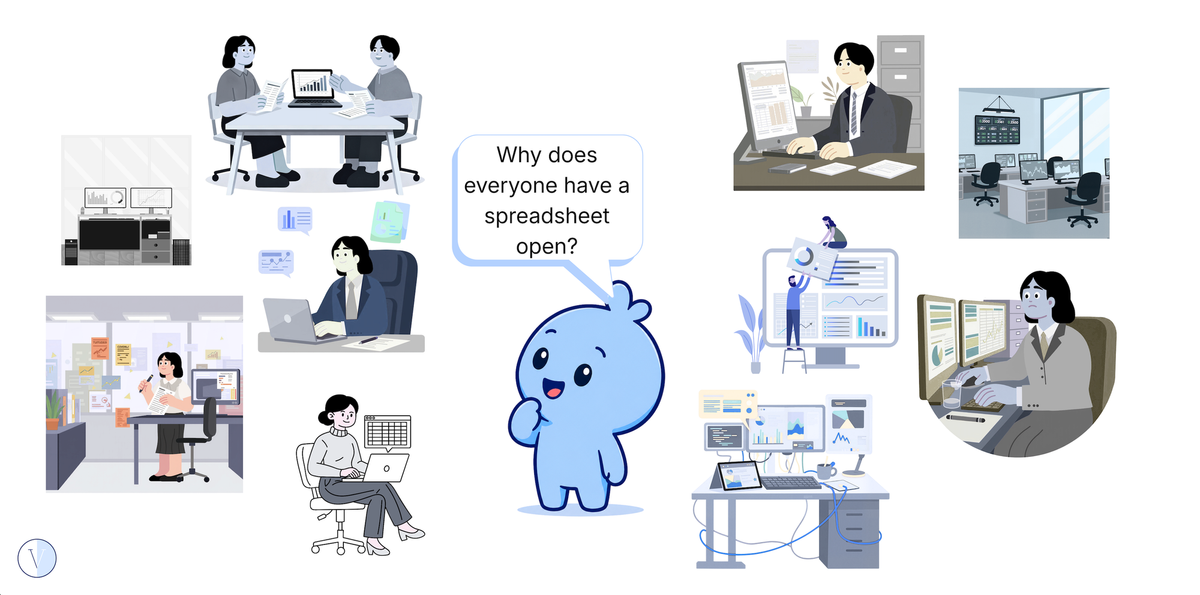
Zombie Spreadsheet: Are You Running Similar Operating System?
Quick check on how much heavy lifting the spreadsheet is doing compared to your official tools... or maybe the spreadsheet is the official-unofficial tool?
Do you know what this is?
Do you have a small spreadsheet factory operations alongside your 'official' systems?
Five quick questions to see whether the behaviour looks familiar before we name the pattern.
Question 1 of 5Scores stay hidden until the end
Is the spreadsheet doing more of the job than the official system?
Five quick questions, stay close to what actually happens, not what the formal process says should happen.
Multiple choice
When the official system cannot show the team what it needs, what happens?
True / false
The team has a spreadsheet that is more current or useful than the official dashboard.
Pick the closest answer
How often is data copied or reconciled between the system and a spreadsheet?
Finish the sentence
When someone asks for the “real number”, people usually…
Scenario check
The spreadsheet disappears tomorrow. What happens?
The formal system has fallen out of step with the work, so a spreadsheet is restoring speed, visibility or local control.
We call this…
The Zombie Spreadsheet
A spreadsheet that has outlived its temporary status and now functions as persistent compensating information operating system beside the formal system.
The four-part read
One pattern always gives four things worth noticing.
This is the same lightweight analytical structure used across the VIEEWS pattern library.
1
Spotting the gray zone
Recognition
The Blueprint: Your company spends millions of dollars on a centralized ERP, CRM, or cloud-native project management platform. The implementation slides look flawless, and the database architecture is theoretically perfect.
The Reality: The formal software requires endless clicks, doesn't reflect real-world field dynamics, and takes six months to update via a centralized IT engineering sprint.
The Signal: The department quietly abandons the official system and runs its mission-timeline off a desktop file named Q3_Actuals_v4_FINAL_REAL_Edits.xlsx passed around via email or a locked access group drive.
2
The immediate shockwave
Impact
The Information Segregation: operational visibility may collapse, frontline teams execute daily tasks based on the localized spreadsheet truth, while executive leadership makes strategic macro decisions based on obsolete, mismatched charts inside the official system dashboard.
The Manual Labour: Highly compensated operations staff spend hours every week on manual data entry, rows manipulation, and cross-checking cells rather than doing their core jobs.
The Blind Spot: Because the project delivery looks successful on paper to the C-suite, leadership remains oblivious to the fact that the expensive enterprise infrastructure is hiding an empty shell wrapped around a rogue Excel file.
3
The hidden utility aka why the pattern persists
Benefits
The Flexible Quick Fix: The Zombie Spreadsheet factor may be restoring local flexibility, speed, and visibility. It allows operators to instantly adapt their data view to match a shifting market reality on a Monday morning without waiting for corporate governance or budget sign-offs.
The Human Interface: Excel acts as the ultimate low-friction sandbox. It provides an intuitive, universally understood environment where non-technical staff can apply custom logic, notes, and context that the rigid corporate software sometimes lacks.
The Flexible Test Environment: It allows localized teams to achieve high-speed problem solving independently, bypassing corporate IT backlogs and tool-sprawl consensus.
4
The long-term impact if left unmanaged
Carry-Over Debt
The Reconciliation Tax: information and audit debt as the company bleeds hundreds of expensive human hours every month forcing teams to argue over whose spreadsheet version is the "single source of truth," leading to decision latency.
The Source of Truth erosion: Running a department on an unmanaged, unrecorded offline asset introduces a high risk of manual formula corruption, broken macros, missing fields, and zero compliance audit trails.
The Key-Person Dependency: i.e. systemic becomes more irrelevant as the entire operational subsystem is heavily dependent on the specific individual who built the original sheet. If the macro creator resigns, the unmapped shadow infrastructure breaks, leaving new hires/teams with an unreadable process learning burden.
AI Impact Overview If AI or automation reads only the official system, without additional context, it may miss the local truth the spreadsheet is carrying. If it reads the spreadsheet too, the shadow representation can become an even more consequential dependency. Basically, Automations/AI need a dependable streamlined source of truth.
One thing to notice next
Take this back into the wild of your workplace.
Find one important spreadsheet used every week and ask: what does it provide that the official system still does not?
Behind the pattern
Same four lenses, every time.
Recognition, Impact, Benefits and Carry-Over Debt help us follow the gap between formal design and the work people actually build around it.
Recognition → Impact → Benefits → Carry-Over Debt
Deeper dives and toolkits coming soon.
For now, subscribe to keep following what people recognise, share and what patterns we explore next.